
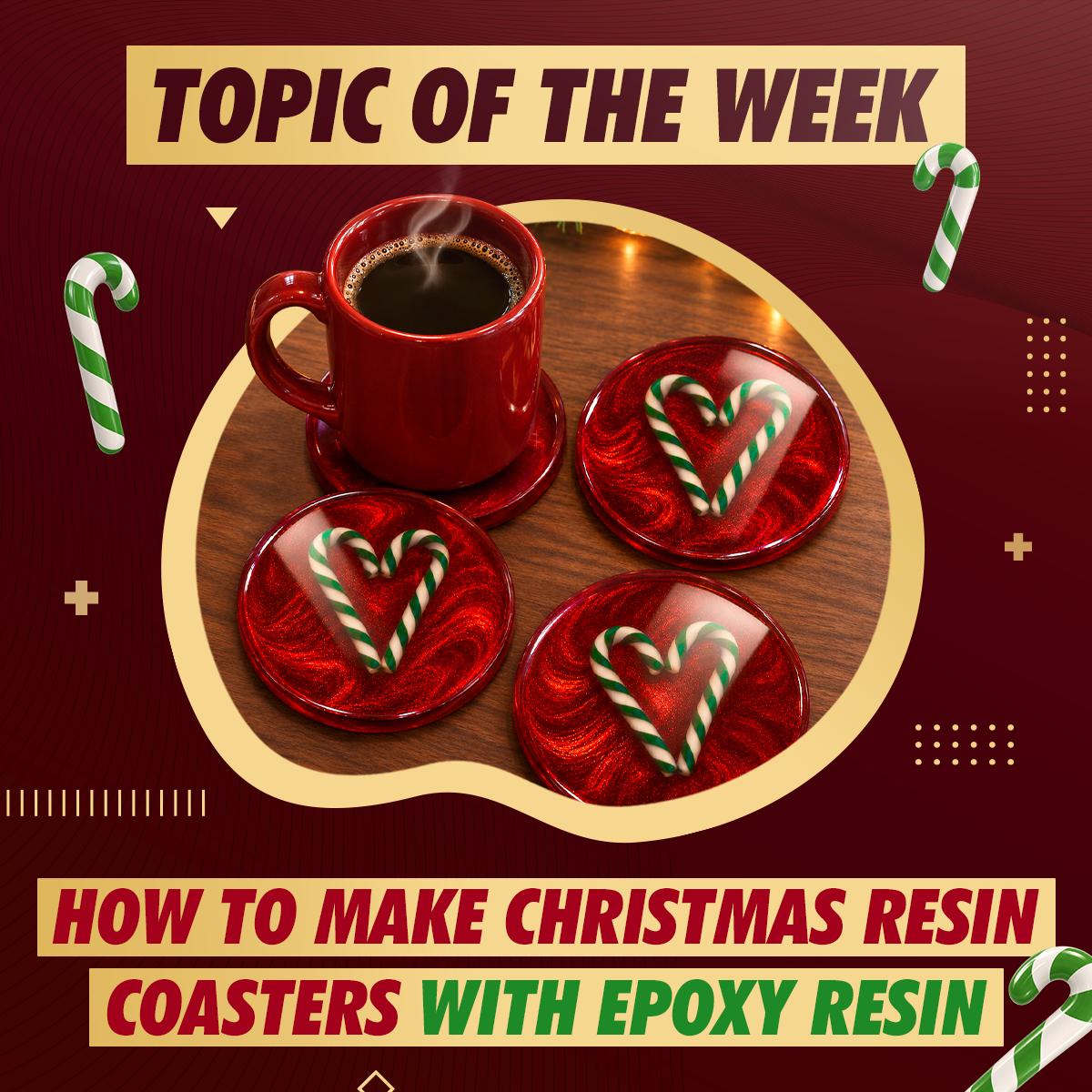
Resin coasters sit in a particular sweet spot for Christmas makes. They're functional, they gift well, they sell reliably at Christmas markets, and the festive colour combinations, deep reds, forest greens, gold and silver, translate into something that looks genuinely considered rather than mass-produced. This guide covers how to make Christmas resin coasters with Craft Resin, from choosing your moulds and colourants through to finishing the edges and adding the final details.
What You Can Make
This guide focuses on round coasters as the primary project, since they're the most versatile and the most in-demand at this time of year. The same technique extends to other festive tableware once you're comfortable with it.
Coasters are the starting point: round or square silicone coaster moulds, festive colours and a clean finish. Once fully cured according to the manufacturer's instructions, resin coasters can be used for cups and mugs. They are not intended as surfaces for preparing or serving food directly. A set of four matching coasters is a natural gift unit.

Serving boards and trays follow a similar approach at a larger scale, but the resin and pouring technique must be suitable for the project's depth. A rectangular tray with festive colours and decorative details makes a statement piece for a gift or a market display. Watch the Santa Snack Tray tutorial below for a step-by-step example of a festive resin tray project.
Festive shaped pieces use the same pour technique but in non-circular moulds: star-shaped trivets, tree-shaped serving boards, snowflake tea-light holders. These take slightly longer to demould cleanly because the shapes have more detail, but they make distinctive pieces that stand out from a standard round coaster.

For a broader look at Christmas resin projects including ornaments, earrings and winter scenes, see our Christmas resin ideas hub.
What You Need
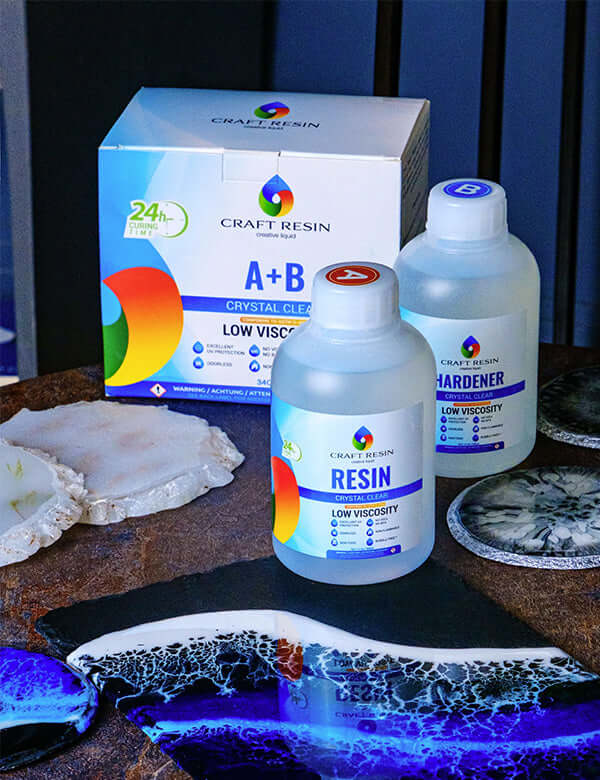
Resin: Craft Resin Arts & Crafts, mixed 1:1 by volume. Arts & Crafts gives you around 35 minutes of working time at 25 °C, which is enough for a session of four to six coasters poured with care. It self-levels, which helps enormously with flat surface pours.
Colour: Mica powder in one colour or a blend. For Christmas coasters, festive combinations include deep red with gold highlights, forest green with silver, midnight blue with holographic glitter, and ivory with gold leaf. Keep the total colourant under 6% of the combined resin volume to help ensure proper curing and maintain the resin's intended properties.
Moulds: Silicone coaster moulds are a practical choice for this project. Choose round or square moulds with a flat base and check the cavity depth before pouring. Make sure the mould is suitable for epoxy resin and that the pouring depth does not exceed the recommended limit for Craft Resin Arts & Crafts.

Other supplies:
- Protective gloves, apron and safety glasses
- Silicone measuring and mixing jugs
- Mixing sticks or a silicone spatula
- Heat torch for surface bubbles
- Flat, level work surface
- Sandpaper in grits from 80 through to 2000 (for edge finishing)
- Cork sheet and adhesive (optional, for adding feet)
- Plastic sheeting or silicone craft mat to protect your workspace
Safety Before You Start
Wear nitrile gloves for every pour. Resin and hardener are chemical substances, and while Craft Resin Arts & Crafts is formulated for low odour and is suited to home and professional use, skin contact with uncured resin is something to avoid. If resin does contact your skin, wash it off immediately with soap and water.
Work in a well-ventilated area, particularly while mixing and pouring epoxy resin. Ensure there is good airflow throughout your workspace and avoid working in small, enclosed spaces with poor ventilation.
Once fully cured, Craft Resin Arts & Crafts coasters can be used for incidental food contact. In practice, a cup of tea or coffee on a fully cured coaster is generally fine, but keeping hot pans directly off the surface is the sensible habit. For a full breakdown of safety in use, see our safety guide.
How to Make Christmas Resin Coasters: Step by Step
Step 1. Prepare your space
Lay plastic sheeting or a silicone mat across your work surface. Resin moves further than expected during a pour, and the protection takes minutes to put down and hours to clean up without. Place your coaster moulds on a completely flat, level surface. Arts & Crafts self-levels during cure, so any tilt in the work surface will tilt the finished coaster.

Get the room to 21–27 °C before you begin. Temperature affects both the working time and the cure quality. A cold room extends working time but slows the cure and can cause issues with the final clarity. If the room drops below 15 °C, warm the sealed, closed bottles in a bowl of warm water to around 30 °C for 10 minutes before mixing, keeping lids on throughout.
Step 2. Plan your colour

Before mixing anything, decide on your colour approach and have your colourant ready. Some useful combinations for Christmas coasters:
Deep red and gold: Add deep red mica to your mixed resin, then pour a small separate batch with gold mica. After the red base is in the mould, drop spots of gold onto the surface and pull through with a cocktail stick for a swirled effect.
Forest green and silver: The same approach as above but cooler in palette. Adding fine silver glitter to the green base before swirling gives a frosted quality.
Clear with festive embeds: Pour a thin clear base, wait a few minutes for it to settle, then carefully place dried holly, pressed fern or small star confetti on the surface. Allow the first layer to become sufficiently firm to hold the inclusions in place before adding a second clear layer to encapsulate them fully. Keep each layer within the recommended maximum pour depth of 6 mm.

Midnight pour: Deep navy or black resin with gold leaf pressed in and holographic glitter. Dramatic and versatile well past the Christmas season.
Have your chosen colourant measured and ready so you're not reaching for things once the clock has started on your working time.
Step 3. Measure and mix
For a typical round coaster mould, you'll need roughly 30–38 ml of mixed resin, depending on the exact diameter and depth of the mould. Check your mould's capacity before mixing to avoid preparing too much or too little resin.
Measure Craft Resin Arts & Crafts resin and hardener in a 1:1 ratio by volume, then combine and mix slowly for at least 5 minutes, scraping the sides and base of the mixing container as you go.
A rushed or incomplete mix can cause sticky spots and soft patches in the finished coaster. If you're colouring the resin, add the mica or pigment once the resin and hardener are fully combined, stir thoroughly, and then proceed to pour.
Step 4. Pour and work the surface
Pour the mixed resin slowly into each mould cavity, working from the centre outward. Arts & Crafts will flow to fill the shape. Don't rush the pour and don't overfill, as overfilling causes overflow that sticks to the sides of the mould and complicates demoulding.
After pouring, watch for surface bubbles over the next few minutes and clear them with a heat torch, using slow sweeping movements without lingering in one spot. You have around 35 minutes of working time at 25 °C to make surface adjustments before the resin begins to thicken.
If you're swirling two colours, do it now: use a cocktail stick or a thin tool and work with light, deliberate movements. Less is more with swirling. The result after 24 hours is often more defined than it looks in the wet resin, so err on the side of restraint.
Step 5. Cure
Cover the moulds loosely with a cardboard box or sheet to keep out dust, pet hairs and debris, and leave everything completely undisturbed at 21–27 °C for 24 hours minimum. Don't move the moulds, don't check them, don't touch the surface.
Craft Resin Arts & Crafts coasters typically become firm to the touch after 24 hours at 25 °C, but the curing process continues, with full mechanical strength developing over approximately 21 days. Once the coasters are firm enough to demould, place them on a clean, flat surface and allow them to continue curing. Avoid stacking or packaging pieces that are still flexible or insufficiently cured.

Step 6. Demould
Gently flex the silicone mould inward from the edges to break the seal, then press from the back to release the coaster. Work slowly and apply steady rather than sharp pressure. Silicone is forgiving but a sudden force can leave an indent in a coaster that hasn't quite reached full hardness.
If the coaster is still very slightly flexible when you demould it, place it face up on a clean flat surface and leave it to continue curing rather than stacking or packaging it.
Step 7. Finish the edges
Even with a clean mould and a careful pour, the edge of a cured resin coaster will have a faint mould line and possibly small drips or overflow. These are straightforward to remove.
Start with 80-grit sandpaper on the edge, working around the circumference until the mould line is gone. Move through progressively finer grits: 120, 220, 400, 800, 1200, 1500 and 2000. Wet-sand from 400 grit upwards to help reduce airborne dust and achieve a cleaner finish. Wear appropriate dust protection and work in a well-ventilated area when sanding cured resin. Each grit removes the scratches left by the previous one. At 2000 grit, the edge will have a slightly frosted appearance.
To restore a fully glossy edge, either buff with a polishing compound and a soft cloth, or brush a thin layer of fresh resin over the sanded edge and allow it to cure in place. Rest the coaster on an upside-down cup or small stand while this cures so the edge doesn't touch anything below.
For more on getting clean, smooth coaster edges, see our dedicated guide to finishing coaster edges.
If you want a high-gloss top surface as well, our guide to applying a resin top coat covers the process.
Festive Finishing Touches
Once the edges are finished, a few small additions significantly improve the final presentation.
Cork feet: Cut three or four small circles of cork sheet (available from craft shops) and attach them evenly around the underside of the coaster with a suitable adhesive. Cork feet help protect the surface underneath, reduce slipping, and give the finished piece a more polished appearance.
Gold or silver edge detail: Run a metallic permanent marker around the rim of the coaster for a clean edge finish that hides any remaining frosting from sanding and adds a decorative quality. This is faster than a resin edge coat and very effective.

Coaster presentation: A set of four matching coasters wrapped in tissue and placed in a simple kraft gift box presents beautifully as a Christmas gift and is significantly easier to package than individual loose pieces.
Personalisation: A small initial, a year, or a short message can be incorporated into the design using decorative letters or other suitable inclusions embedded in the resin. Make sure all decorative elements are securely positioned before adding the next layer. Personalised coasters also make thoughtful Christmas gifts and can be offered as custom orders.
Selling Christmas Resin Coasters

Coasters sit at a comfortable mid-price point for a Christmas market or an online shop. A single coaster makes a stocking filler; a set of four in coordinated colours is a proper gift. Both sell.
The key to coasters selling well at markets is showing them in use. A coaster under a mug on a simple display cloth looks immediately more appealing than a coaster propped up on a stand in isolation. Make the display feel domestic and functional, because that's exactly how the buyer is imagining using it.
For online listings, photograph from directly above on a clean, well-lit surface and include at least one lifestyle shot showing the coaster in a Christmas setting, under a mug or as part of a gift arrangement.
You can also increase the average order value by offering matching sets and clearly signposting personalisation options. A buyer who came for a single coaster and discovers they can get a matching set of four with a family initial often buys the set.
Resources for selling festive resin work:
Frequently Asked Questions
Can you use resin coasters for hot drinks?
Craft Resin Arts & Crafts has a heat resistance of up to 80 °C. Fully cured resin coasters can be used for cups and mugs, including everyday tea and coffee. However, heat resistance is a property of the material, not a guarantee against damage from hot objects. Avoid placing hot cookware directly on the resin surface.
How do you finish resin coaster edges?
Sand progressively from 80 grit through to 2000 grit, working around the edge until the mould line is gone and the surface is smooth. Then either buff to a shine with polishing compound, apply a thin fresh resin coat to the edge and let it cure, or run a metallic marker around the rim for a decorative finish. The full technique is explained in Step 7 above.
Can resin coasters come into contact with food?
Craft Resin Arts & Crafts is suitable for incidental food contact once fully cured. This does not extend to food storage, prolonged contact, cutting surfaces, drinking vessels, serving hot food or dishwasher use.
What's the difference between resin coasters and resin cutting boards?
Coasters are primarily decorative functional pieces designed for cups and mugs. Cutting boards are intended for food preparation and require different finishing and usage considerations. For the specifics on resin cutting boards, see our guide to epoxy resin cutting boards.
How long do resin coasters take to cure?
Craft Resin Arts & Crafts coasters typically become firm to the touch after 24 hours at 25 °C, while full mechanical strength develops over approximately 21 days. Allow the coasters to continue curing on a clean, flat surface after demoulding, and avoid stacking or packaging them while they are still flexible or insufficiently cured.
Shop the resin used in this guide